Examining the legal consequences, spoliation sanctions, and evidentiary presumptions when commercial property owners fail to preserve video evidence.
The Duty to Preserve Evidence in Commercial Settings

Commercial property owners and business operators are not automatically required to keep surveillance footage forever. Most automated security systems loop footage, overwriting older data every 7, 14, or 30 days to save storage space.
However, a legal duty to preserve evidence arises the moment a business receives actual or constructive notice of a potential legal claim. Notice can be triggered by several events:
- An incident report filed on-site immediately after an injury.
- Direct verbal or written communication from the injured party or their representative.
- Receipt of a formal Spoliation Letter (or Preservation of Evidence Demand).
- Service of a summons and complaint initiating a lawsuit.
Once this duty is triggered, a business must take affirmative steps to pause automated deletion protocols and isolate relevant video files covering the incident window, including reasonable time frames before and after the event.
How Courts Address Destroyed or Missing Surveillance Video
When a defendant business allows key footage to be destroyed after the duty to preserve has attached, trial courts possess broad discretionary power to impose sanctions. Depending on the jurisdiction and whether the destruction was accidental or deliberate, courts apply several corrective legal remedies:
1. The Adverse Inference Instruction
The most common remedy for spoliation is an adverse inference jury instruction. The trial judge instructs the jury that they may presume the missing security video contained evidence harmful to the business owner and favorable to the injured party. This instruction effectively bridges gaps in the plaintiff’s proof regarding how long a hazard existed or whether store employees failed to conduct routine safety inspections.
2. Evidentiary Preclusion Sanctions
If a court determines that a commercial entity acted with gross negligence or bad faith, it may bar the defense from presenting certain arguments or testimony. For example, if a business destroys video of a spill site, the judge may prohibit the business from arguing that its staff exercised reasonable care or conducted regular floor sweeps prior to the fall.
3. Striking Pleadings and Default Judgment
In extreme cases involving willful destruction or severe bad faith—such as intentionally deleting footage after receiving a formal litigation hold—courts may strike the defendant’s answer entirely, granting a default judgment on liability in favor of the plaintiff.
Proving Intent vs. Routine Business Practice
Courts carefully distinguish between routine digital maintenance and bad-faith spoliation. Under Rule 37(e) of the Federal Rules of Civil Procedure (and parallel state codes), sanctions for lost electronically stored information (ESI) depend heavily on whether the party acted with the intent to deprive the opposing party of the information.
If a business fails to preserve video simply because it routinely recycles hard drive space every 14 days and had no prior notice of an injury, sanctions may be limited. Conversely, if an incident report was completed on day two, but management failed to pull the footage before the automatic wipe on day fourteen, courts frequently find failure to take reasonable steps, opening the door to spoliation remedies.
Steps to Take When Security Footage Is Withheld or Missing
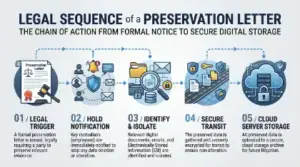
Building a strong record around digital evidence preservation requires immediate, strategic steps following an injury on commercial property:
- Send a Detailed Preservation Demand Immediately: Draft and deliver a formal letter via certified mail specifying the exact dates, times, camera angles, and physical locations that must be saved.
- Request System Metadata and Retention Schedules: Obtain the technical specifications of the business’s closed-circuit television (CCTV) system, including maximum retention periods and automated overwrite settings.
- Subpoena Third-Party Vendors: Many commercial facilities outsource security operations to third-party monitoring companies, which may retain independent cloud backups even if local store managers failed to save the files.
Protecting the Integrity of Commercial Liability Claims
In general liability and premises claims, video evidence remains an irreplaceable window into the truth of an incident. When commercial entities fail to protect these critical records after notice of a claim, the doctrine of spoliation ensures that accountability cannot simply be erased alongside the video files.